

Why is story structure important?
- Anithra W

- May 17, 2020
- 6 min read
Updated: May 17, 2020
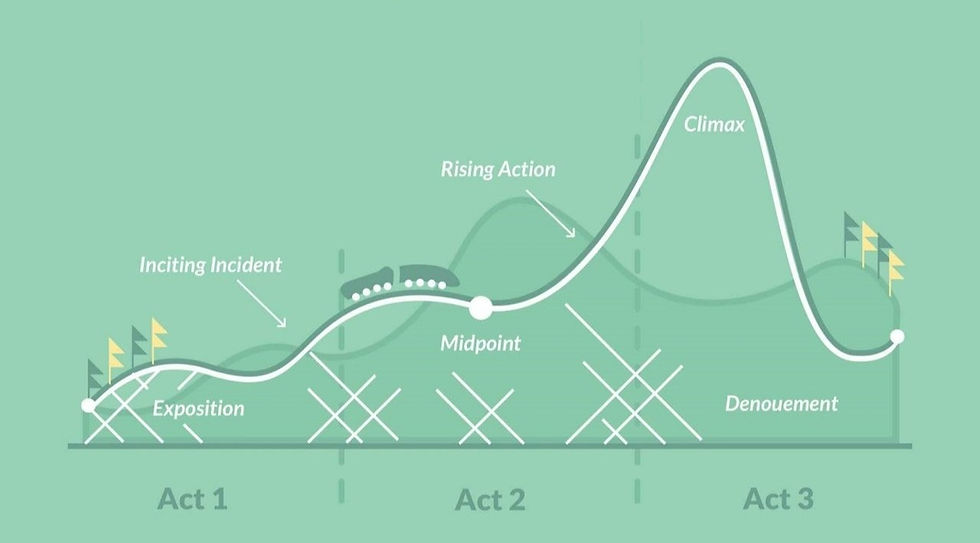
image from reedsy.com
Imagine your story as a roller-coaster ride.
If you have too many peaks without enough gentle bumps, people will throw up. If the peaks aren't high enough, they'll forget the ride as soon as they got off. If the peaks are all near the beginning with none left for the end, they'll tell their friends the ride was boring. If you've saved all the peaks for the end, someone will try and escape the roller-coaster before the ride's even finished!
This is your roller-coaster. You are the designer, architect, engineer and constructor. You want people to love the ride while ensuring it's absolutely safe. And while you get all kinds of rides, the ones that draw people back again and again are design to make you anticipate the ride. From the moment you strap yourself in the seat, you are in a state of anticipation that the ride will be amazing.
The metal you build your track from has to withstand the weather and heat. The parts need to be screwed together precisely with very specific nuts and bolts.
Forging ahead with awful planning and shoddy construction will cause your roller-coaster to collapse on your poor riders. We want visitors, so let's try and avoid a situation where they're trying to pull themselves out of the rubble of our weak story foundation.
Why is structure so important? To make sure your story holds up.
Thankfully, it's easier to fix the broken structure of a story than a roller-coaster. It will take some care and patience, but the result will be worth it.
The 3-Act Structure
You’ve likely heard of the 3-Act structure of storytelling:
1. SETUP
2. CONFRONTATION
3. RESOLUTION
Or as anyone can usually explain it: The Beginning, Middle and End.
So here we have our classic 3-Act structure, as presented by Syd Field in a manner that dissects a time-and-tested successful screenplay.

Act 1: Setup
Stories tend to start at the beginning—an admittedly good place to start. Act 1 sets up your story’s world and characters in a kind of teaser for what is to come. And that teaser—that promise of an awesome story—comes into play with the ‘inciting incident’. This is the first game-changer as the event that rocks your main character’s world. It is the call to action, an event that can’t be ignored. It is also the point at which your reader may decide to chuck your book aside if they’re not compelled enough, so set up those stakes and ensure your characters are worth caring about.
Act 2: Confrontation
The middle is where things tend to get out of hand for your characters. For writers, this can be the most difficult act to write, and not just because it tends to be twice as big as Act 1 and 3. It is, in essence, half of your novel. As the longest act, and sandwiched between Act 1 and 3, it is more prone to the dreaded mid-novel slump—a meandering slog of filler and lost tension. But Act 2 needs to keep your reader turning the pages. The stakes should be even higher, ratcheting up the obstacles and the very real possibility of failure. Your pacing should drive onwards with calm moments in between scenes of high tension for your characters to reflect and your readers to breathe.
Act 3: Resolution
Breathless with anticipation, we hurtle at last towards the much-awaited climax. Not that the journey itself isn’t important, but after flipping through all those pages, your readers have earned the ending. They want you to deliver on the promise that you set up in Act 1 and made them chase through Act 2. And, yes, the weight, the demand, of this expectation can be daunting. But when you’ve finally penned that climax, the resolution—whether happy, sad, or bittersweet, should follow swiftly without dragging on and losing impact.
The 6-Stage Structure
So now we’ve recapped the 3-Act Structure, have you heard of the 6-Stage structure? In both cases, Act 2 is again smack bang in the middle and double the size. You could look at this as a more precise dissection of the 3-Act structure as shown here by Michael Hauge.

These are the six stages of Hauge's story structure:
Setup
New situation
Progress
Complications and higher stakes
Final Push
Aftermath
If you're novel feels out of balance, it's worth checking your story beats against these six stages. Though the idea of quantifying something so creative can feel a bit soulless, it’s an excellent way to identify all the developing moments in your story. You don’t have to follow this as a play-by-play ultimatum, of course, but it makes for a great guide.
Analysing plot structures of existing books
Analysing the plot structure of books can be a great exercise.
As an example, let’s look at Harry Potter and the Philosopher’s Stone (or Sorcerer’s, if you have the American version instead of the British). I grew up with the series and the first five books have loose pages from the number of times my sister and I have reread them.
My copy of the Philosopher’s Stone has 223 pages, so let’s use this guideline to calculate the breakdown:
0 -10% -- Setup
10 - 25% -- New situation
25 - 50% -- Progress
50 - 75% -- Complications and higher stakes
75 - 90-99% -- Final Push
[90-99] - 100% -- Aftermath
To calculate where all the percentages fall in the book, we first need to find out 1% of 223 pages.
Simply divide 223 by 100 to get 2.23, and then multiply 2.23 by whichever percentage you want. For example, 10% would be 2.23 x 10, which would be 23.3 (or roughly 23 pages).
If I calculate all the turning points this way, I end up with this:
10% - Opportunity - page 22
25% - Change of plans - page 55.
50% - Point of no return - page 112
75% - Major setback - page 167
[90-99]% - Climax - page 201–221
This is a rough guide, and I allowed a margin of a few pages before and after each turning point. After finding the corresponding turning pages in my book, this is the overview of the structure:
0—10% (Setup)
We are introduced to 11-year old Harry and the dreadful Dursleys. Rowling entices our sympathy for poor Harry straight away and though the Dursleys seem to take pride in their normality, we learn of strange incidents involving Harry that hint that he is quite your ordinary 11-year old.
10% --> Opportunity
Harry convinces the Dursleys to let him tag along to the zoo for Dudley’s birthday, where he somehow frees a bored talking snake by making the glass vanish.
10—25% (New situation)
This is where, after receiving a flurry of mysterious letters Uncle Vernon refuses to let Harry read, they find themselves in a little shack on a rock way out at sea. Hagrid, of course, tracks him down and reveals all to Harry with the famously quote “Yer a wizard”. This is most certainly a new incredible situation as Harry learns about the world that was hidden from him his whole life.
25% --> Change of plans
Hagrid introduces Harry to the wonderful magical location of Diagon Alley to get his school supplies. This is our first true entry into the wizarding world.
25—50% (Progress)
Harry gets his own wand, meets the wizarding community, runs into antagonist Draco, locates Platform 9 ¾, travels to Hogwarts, makes his first true friend in Ron, gets sorted into Gryffindor, has magic lessons, and rides his first broomstick. These are all exciting and significant milestones for young Harry in a world which is intriguing and exciting.
50% --> Point of no return
After taking to the skies to get Neville’s Remembrall back from Draco, Harry is reprimanded by Professor McGonagall (and is subsequently made Seeker of the Gryffindor Quidditch team!)
50—75% (Complications and higher stakes)
Harry discovers the three-headed dog guarding the mysterious package from vault 713, fights a troll on Halloween, nearly falls off his broomstick in his first Quidditch match, learns of Nicholas Flamel, anonymously receives an Invisibility Cloak, stumbles upon the Mirror of Erised, realises the existence of the Philosopher’s Stone, and suspects Snape of trying to steal the stone. The stakes are definitely raised with the growing sense of danger.
75% --> Major setback
Harry, Ron and Hermione believe Snape is forcing Quirrell to steal the stone, but when they learn Hagrid has an illegal dragon’s egg, they also have an additional problem to worry about.
75—[90-99]% (Final Push)
After being caught roaming around Hogwarts at night after sending off the hatched dragon, Harry and his friends are punished with detention. Still, they persevere to save the Philosopher’s Stone, using their wits and friendship to bypass the magical security measures. Ultimately, Harry must progress alone and he ventures onwards to battle the villain.
[90-99]% --> Climax
Here, we have a great plot twist where Harry realises that its’s not Snape, but Quirrell who is trying to steal the stone. Harry fights bravely and is successful in preventing Quirrell from taking the stone.
[90-99]—100% Aftermath
Harry and his friends are awarded house-points for their efforts, securing the win for Gryffindor in what is Harry’s best moment in life so far. As the school year ends, he returns to the Dursleys with excitement for the future.
And there, you can see how well Rowling has structured the first book of the beloved Harry Potter series. You can use this technique to analyses books you like--or even didn't like-- you might find that the story structure played a big part in how engaged you were.
In my post ' How to plan your story structure with Excel ', I show you how to analyse the structure of your own work using helpful visual methods!


Comments