

Dealing with social anxiety
- Anithra W

- May 15, 2020
- 5 min read
Updated: May 17, 2020
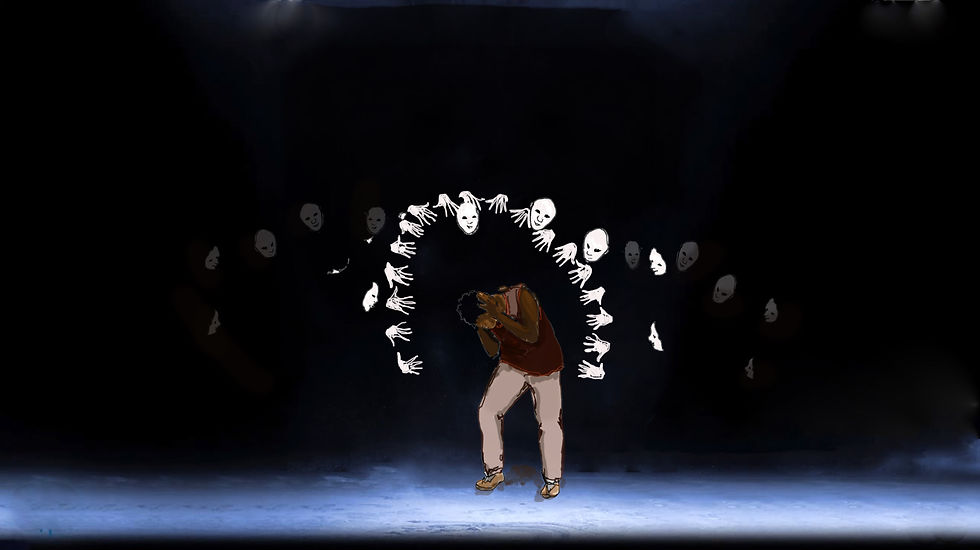
Social Anxiety is shyness taken to the next level—a level where you just can’t seem to defeat the monsters no matter what you’re armed with. It’s persistent.
It closes the doors and all the windows so that you’re left peering out through the mail slot.
You’re looking for the tinned tomatoes in the grocery store. You’ll walk round and round again, through the aisles, seven times over instead of asking the shelf-stocker. You need to put the recycling outside but you’ll do it later because there’s a group of kids lounging against the wall directly opposite across the street. You muffle the phone under the covers or press the answer button, stay silent through the ‘Hello?’s and pass it off like the speakers weren’t working.
One Physics lesson when I was younger, the teacher asked a question and said the first to get it right would get a house-point token. I knew the answer but I thought others would answer. And they did. Their hands went up, one by one. Nope. Wrong. They began calling out random words now. After the ideas fizzled out, they went quiet.
So, finally, I snuck my hand up. I got it right. He said to come to his desk after the end of the lesson to collect the point token. After the lesson, I didn’t go. I was too shy, self-conscious, embarrassed to collect a reward. Who looks at a reward like a death sentence? For the class yearbook, when each student was given a label for ‘Most Something’ , mine was ‘Most Quiet.’ I almost cried. It can really block your life.
There you are, all ready to go—shoes tied, jumper zipped, house keys-check! And you open the door to step outside and there’s social anxiety in your face, holding a giant trombone and plastering its shoes all over your welcome mat.
And then, before you can kick it away, it raises the trombone and the most ghastly noise comes out of it. The world turns to stare at you, social anxiety shoves the trombone into your hands and then turns invisible. You just want run back inside and slam the door.
Why is it so difficult to break into a sheepish grin, hold up the trombone and say ‘Better stick to piano’? Talking to someone can be difficult. Face to face, out there in the open for them to notice your palms sweating, your voice tripping, your chest thumping. And that’s with visual cues, giving you the chance to interpret and respond accordingly.
The phone. The phone is worse. The ringing gets you first. There you are, minding your own business, engrossed with your own thoughts, your own bubble and then it rings. Frantically scan the caller ID to check if you know who it is. Sometimes, talking to someone I know seems almost as hard as talking to a stranger. Maybe a stranger eliminates the threat of judgement; they don’t know you yet so there’s no basis for preconceptions.
Ring. Should I pick up? Ring. Should I pick up? Ring, ring, ring.
Floundering around for words, the silences that burrow into the ground, the polite ‘Sorry, what was that?’ that makes your throat die so that they end up asking you to repeat it two more times.
When your pitch changes, skipping so high it hurts your own ears, or when you backpedal through your own voice in your head and end up missing what they said.
Pace. Walk back and forth, trying to stamp out the nervous energy.
Run up the stairs or shutting yourself in the room so that no one will stare at you as you fumble through the call.
I thought it would get easier with ‘practice’. I say practice with reluctance because that just forces you to be around more people which shoves in the anxiety again and takes you back full circle to nowhere. That club you want to join because it looks interesting? Too embarrassing since you’ll be a beginner. Presentation in front of the audience has to be the killer.
Large crowds have too many people, too many voices, too many personalities. One to one’s might be tolerable but what if you run out of things to say? What kind of conversation is a one-sided one?
This time, social anxiety rocks up with a full out orchestra band.
And he forgot the conductor. Really S.A? You might as well
have just knocked me out with the trombone. And let’s not
use nicknames here because those are only for friends. Friends
don’t whisper in your ears you look stupid. Sound stupid.
It’s all there, draping itself all over you without getting a clue.
Are there any benefits at all? Is there anything at all that might allow us to consider inviting social anxiety in past the welcome mat, or at least, give us a grudging one-armed hug? He’s still got the trombone in the other and, even without the thing, two arms would be pushing it. No offence to the busker in Piccadilly underground. But now we’d given it more thought, let’s try a checklist:
You’re more empathetic towards other people.
You’re more humble.
You think before you speak.
You think before you act.
You’re more aware of your own feelings.
Is this worth the negatives?
You find it difficult to communicate.
You turn down opportunities.
You filter your words.
You filter your actions.
You never really express your own feelings.
Let’s stop there, because I think we’ll just have to keep social anxiety at arms length. My best interactions have been the best: Jokes, laughs, praises—everything good. The worst...a raised eyebrow? A sigh. An eye roll. But not a sneer. Not a snide comment. Not a cruel snigger followed by a declaration that the conversation will be posted online for the rest of world to see.
So when the best was fantastic and the worst was only bad, why do we still anticipate catastrophe?
We’re scared of the judgement. We tend to remember the negative, rather than the positive. Which do you remember more—that awful nightmare or that epic dream? Sometimes the anxiety is none existent with certain situations and certain people. Other times it flares up like a tornado, churning away inside.
Should we increase our exposure gradually? Yes, we want to gain a better hold over our lives, but let’s not throw ourselves into the deep end—we can’t swim, remember? At least not in the pool of anxiety. But we can still gain a bit more control:
Little conversations, picking up on common interests that you have. If you don’t seem to have any, allow your curiosity of uncommon interest to show through!
Maybe putting your favourite song as your ringtone. The familiarity may ease your nerves.
Picturing a friendly face, friendly voice and good intentions when picking up the landline, without thrusting the phone at someone else. Holding forth your reasoning—no one will ever look at you as critically as you think they will.
Putting situations into perspective—this circumstance will never get as bad as you assume it will. If it does...you’ve survived the worst.
Compile enough good social experiences so they steer your mind. Smile too—it’s amazing how a smile can ease your nerves and hold out an invitation to a stranger. And being helpful. Whether it was just picking up a dropped pen or taking the time to sit down with someone and explain how to thread up the sewing machine properly, it would always be appreciated. Appreciation seems to kick-start confidence and thereby ease your nerves. I’m much better now.
It’s still there. It’s there and it’s hard.
I don’t think you can ever really close the door on social anxiety—it will always linger before your words, your voice, your confidence and your rationality. But don’t let it steal your dreams away. Even if it feels like that tug-of-war’s will go on forever, hang in there.
I promise you can do it.
#socialanxiety #motivation #writing #WixBlog

Comments